Rent Collection Software for Landlords: What to Evaluate Before You Buy
Get expert property management insights, straight to your inbox.
Rent collection software for landlords is not a complex purchase, until you're six months into the wrong platform and migrating payment records manually.
Most evaluation mistakes happen before the first demo. Landlords compare pricing pages instead of workflows, test the payment experience without checking what happens to the data afterward, and overlook the fee structures that tenants will eventually push back on.
This guide covers what rent collection software should handle, how to compare platforms without being misled by surface-level features, and what separates a payment tool from a system that holds up as your portfolio grows.
What is Rent Collection Software in Property Management?
Rent collection software is a centralized platform that replaces paper checks, manual tracking, and scattered spreadsheets with a single system for receiving and recording rent payments.
At minimum, the software gives tenants a portal for collecting rent online, with ACH transfers, credit cards, and debit cards as standard payment options. Payments log automatically, late fees apply based on configured lease terms, and reminders send on schedule.
What separates this from a basic payment processor is its structure. Most platforms include:
- Recurring payment schedules and automated rent reminders
- Partial payment tracking with complete payment history records
- Late fee rules tied directly to lease terms
- Financial reports for income tracking, expenses, and tax season
Many platforms are built into more comprehensive property management software, connecting rent collection to maintenance requests, tenant communication, and lease management. Others are standalone tools built only for transactions.
The difference matters at evaluation time. A payment tool processes money. A full platform manages the workflow around it.
What Rent Collection Software Should Handle for Landlords
Online Rent Payment Processing for Tenants
The payment experience matters to tenants more than most landlords expect. Tenants who can't easily pay rent online pay late more often, inconvenience builds, and small barriers become consistent habits.
Solid rent collection software provides tenants with a dedicated tenant portal to pay via ACH transfer, credit card, or debit card without contacting the landlord. ACH transfers typically process within 1–3 business days. Same-day ACH is available on select platforms, reducing the gap between payment initiation and funds received.
Processing fees are platform-specific. Most charge tenants 2.95%–3.49% for credit card payments. ACH fees vary, some platforms absorb them, others pass them to tenants. Know which model a platform uses before committing.
Bank-level encryption and identity verification should be standard on any platform handling rent transactions.
Automatic Late Fee Enforcement for Rental Properties
Manual late fee enforcement is inconsistent. Landlords forget, delay, or apply rules unevenly, and tenants notice.
Rent collection software removes that inconsistency. Late fees trigger automatically based on configured parameters: grace period length, flat fee or percentage, and compounding rules. The system applies them the same way every time, regardless of how many units you manage.
The detail worth checking: can fees be customized per lease agreement? A blanket rule works for a uniform portfolio. Across mixed property types, you'll need a per-unit or per-lease configuration.
Some platforms also allow one-off fee waivers while keeping the automated rule intact, which is useful when a long-term tenant has an isolated issue and a rigid system would do more harm than good.
Recurring Payment Scheduling for Monthly Rent
Tenants set up automatic payments once. Rent pulls on the same date each month. Neither party does anything.
The practical impact for landlords: fewer missed payments, fewer manual reminders, and less time spent on follow-ups that don't need to be manual. Across a growing portfolio, that time reduction adds up quickly.
Two things to verify before settling on a platform:
- Failure handling: When a payment fails due to insufficient funds, does the system notify both parties automatically? Does it retry?
- Partial payment rules: Can tenants submit partial payments, and does the platform flag them accurately against the full balance due?
A recurring schedule that fails silently creates more confusion than a manual process would have.
Rent Payment Tracking Across Multiple Units
Tracking rent across one unit is straightforward. Across ten or twenty, it becomes a data management problem.
Software built for multi-unit portfolios maintains a running ledger per unit, logging every payment, partial payment, late fee, and adjustment in one place. Landlords can see at a glance which units are current and which are outstanding, without cross-referencing bank notifications or separate spreadsheets.
For property managers reporting to owners, the ledger feeds directly into owner statements, showing income received, amounts outstanding, and variances from expected rent.
Worth checking separately: how the platform handles rent reconciliation. Prorated move-ins, partial months, and security deposits applied to balances all create transactions that need to match against the correct charge. Manual correction at that stage defeats the purpose of the software.
How to Evaluate Rent Collection Software Before Committing
Rent Collection Software Pricing Models for Landlords
The monthly fee is the starting point, not the full picture. Total cost includes what landlords and tenants pay and what triggers each charge.
Most platforms follow one of three structures:
| Model | How It Works | Watch For |
|---|---|---|
| Free for landlords | Tenants cover processing fees, 2.95%–3.49% for credit cards, variable for ACH | Tenant friction; card fees reduce willingness to pay that way |
| Flat monthly fee | Landlord pays a fixed subscription; tenants pay nothing per transaction | Per-unit pricing that compounds as the portfolio grows |
| Per-transaction fee | Either party pays a set amount per payment processed | High volume across multiple units makes costs unpredictable |
ACH transfers are typically the lowest-cost payment method on any platform, often free or near-free compared to credit card processing fees. For landlords collecting rent across several units, that difference across a full month of payments is worth calculating before choosing.
Free rental management tools usually include basic online rent collection at no cost, but lack features like automated reminders, customizable late fees, or multi-unit financial reports. Knowing where those limits are is part of an honest evaluation.
Portfolio Scalability in Rent Collection Software
A platform that handles three units cleanly may not handle thirty the same way. The question at evaluation isn't whether it works, it's whether it works at the scale you're heading toward.
Scalability in rent collection means:
- Per-unit pricing: Does the cost model stay proportionate as the portfolio grows, or does it become punitive above a certain unit count?
- Cross-property visibility: Can property managers view payment status, outstanding balances, and late payments across all rental properties in a single view, without switching between accounts?
- Expense and income tracking: Does rent income feed into a broader record that includes expenses, move-in fees, and maintenance costs, or does each data point live separately?
- Reporting at scale: Can the platform generate financial reports that consolidate income across units without manual data entry?
Advantage cases matter here. Prorated rent, partial payments on move-in, and mid-cycle lease changes create transactions that don't follow a clean recurring pattern. A platform that handles standard monthly rent well but requires manual workarounds for anything else will slow down as the portfolio grows.
Tenant Payment Experience as a Selection Criteria
Late payments are frequently a friction problem, not a financial one. Tenants who find the rental payment process slow, limited, or unclear will delay, and that delay falls on the landlord.
Platforms that support multiple payment methods give tenants real flexibility: ACH bank transfers, credit cards, debit cards, and, in some cases, digital payment options. Removing credit card payments entirely can push tenants toward methods that don't fit their month-to-month cash flow, creating more inconsistency, not less.
Two features with a direct effect on payment behavior:
- Automated rent reminders: Configurable reminders sent before the due date reduce late payments without any manual follow-up. The more control landlords have over timing and frequency, the more useful they are across a varied tenant base.
- Rent reporting to credit bureaus: Some platforms report on-time payments to major credit bureaus, giving tenants a concrete reason to consistently pay through the platform. Tenants with something at stake in their credit history and credit scores tend to stay current. The landlord-tenant relationship benefits when the payment system works in both directions.
A mobile-accessible online portal rounds this out. Tenants who can pay rent online, view payment history, and receive automated reminders from one place have fewer practical reasons to fall behind.
Mistakes Landlords Make When Choosing Rent Collection Software
Choosing Rent Collection Software That Doesn't Scale With Your Portfolio
Most landlords evaluate software for the portfolio they have, not the one they're building toward. A platform that works for five units may require a full migration at fifteen.
The scaling problems that surface later are rarely about payment processing itself. They show up in the surrounding workflow: maintenance tracking tied to the wrong unit, expense tracking that doesn't cleanly separate properties, and income verification records that require manual consolidation at tax time. Each one is manageable alone. Together, they consume time that a larger portfolio can't absorb.
Automated rent collection helps here, but only if the platform was built to handle volume. Automated reminders, recurring payment scheduling, and late-fee enforcement should work the same way at 20 units as at 5, without manual reconfiguration between leases.
Before committing, ask the vendor directly what changes at 20 units: Does pricing jump? Do any features require an upgraded plan? Does the reporting structure hold across a larger rent roll? Vague answers are a signal worth taking seriously.
Overlooking Transaction Fees in Rent Collection Platforms
The subscription cost is visible. Transaction fees are where most landlords get surprised.
A platform charging tenants 3.25% per credit card payment on $1,500 monthly rent adds $49.50 per transaction. Across ten units where tenants prefer card payments, that's nearly $500 a month leaving the rental process — paid by tenants who may push back, delay, or switch to a payment method the system handles less cleanly.
Fee structures to verify before signing up:
- ACH fees: Free on some platforms, $1–$3 per transfer on others
- Credit and debit card processing fees: Who pays, and at what rate
- Monthly fees per unit: Flat rate or tiered by portfolio size
- Bank transfer fees: Some platforms charge for landlord-side payouts
Payment processing fees vary significantly across platforms. Some pass credit card fees to tenants while offering free ACH transfers; others bundle everything into a flat monthly fee. Neither model is universally better, the right answer depends on how your tenants prefer to pay rent online and how much of that cost you're willing to absorb versus pass through.
Understanding the full fee model on both sides prevents surprises that compound across a multi-unit portfolio every month.
Picking Standalone Rent Collection Apps Over Integrated Property Management Software
A standalone app collects rent. It doesn't connect that payment to the lease, the maintenance record, the expense log, or the bank account reconciliation. Every one of those connections has to be made manually, elsewhere.
That's a workflow most landlords don't notice until they're doing it every month.
Integrated property management accounting solves the disconnect directly, rent payments post to the ledger automatically, late fees are recorded against the right tenant, and income totals are available without a separate spreadsheet. At the end of the year, the records needed for tax preparation already exist in a structured format.
The same applies to tenant management: when rent collection, lease terms, maintenance requests, and tenant communication sit in one system, the payment record has context. A partial payment flags against an active lease. An automated reminder goes to the right contact. A late fee waiver notes against the right account.
Standalone apps create point solutions. Integrated platforms create a record. For landlords managing more than a handful of units, the difference between the two shows up in bookkeeping hours, every single month.
How to Score & Compare Rent Collection Software Options
Comparing platforms without a fixed rubric leads to decisions based on interface preference over actual capability. Build the comparison around what the software has to do, then score each option against it.
Use a weighted scoring model. Not every criterion carries equal weight. Assign points based on what your portfolio requires:
| Criteria | What to Evaluate | Weight |
|---|---|---|
| Payment flexibility | ACH, credit/debit cards, bank transfers, multiple payment options | High |
| Automated rent collection | Recurring payments, automated reminders, and on-time payment rate | High |
| Late fee enforcement | Custom late fees, automatic late fees, and per-lease configuration | High |
| Accounting integration | Syncs with bookkeeping tools, reduces manual data entry, and tracks income | High |
| Security | Bank-level encryption, identity verification, secure transaction handling | High |
| Reporting | Rent reporting, expense tracking, transaction records for tax prep | Medium |
| Mobile accessibility | Landlord and tenant access via mobile for payments and communication | Medium |
| Tenant-facing features | Online portal, rent reminders, flexible payment options, and payment history | Medium |
| Credit reporting | Reports on-time payments to major credit bureaus | Low–Medium |
Score each platform on a 1–5 scale per category. Multiply by weight. Total the result.
Where most comparisons go wrong:
Landlords focus on the rent collection experience and skip the back-end. A platform that makes it easy to collect rent online but exports payment data as a CSV, requiring manual import into a separate accounting tool, creates bookkeeping errors that compound monthly.
Integration with accounting software is a functional requirement for keeping financial records clean.
Security deserves the same scrutiny. Rent payments move sensitive bank account information through the platform on every transaction. Platforms without bank-level encryption and secure verification create exposure that a cheaper subscription price doesn't justify.
Practical comparison steps:
- Run a free trial on two platforms simultaneously: Process at least one test payment, configure automated rent reminders, and set a custom late fee rule. See which takes less time to configure correctly.
- Check the reporting output: Generate a sample financial report. Does it show what you'd need for tax season as a landlord? Does it separate income by unit?
- Test the tenant payment flow: Log in as a tenant. Can they pay rent online, view payment history, and receive automated reminders without contacting you? If the process is unclear to you, it will be unclear to them.
- Ask specifically about partial rent payments: How does the platform record them? Does it flag the balance automatically, or does that require manual tracking?
- Read the comparison data: Side-by-side breakdowns like MagicDoor vs Buildium show feature-level differences that vendor marketing pages won't surface.
Property management software that handles rent collection as part of a more comprehensive system, maintenance tracking, lease agreements, tenant communication, expense tracking, will score higher on integration criteria than a standalone payment tool.
That difference becomes more significant as the unit count grows, because every disconnected data point eventually requires manual reconciliation.
A mobile-friendly interface matters on both sides of the transaction. Landlords who manage rent collection from a phone need the same visibility they'd have at a desk. Tenants who can't easily access their online portal on mobile will find reasons to delay, and those delays accumulate into a pattern.
Why Landlords Use MagicDoor for Rent Collection
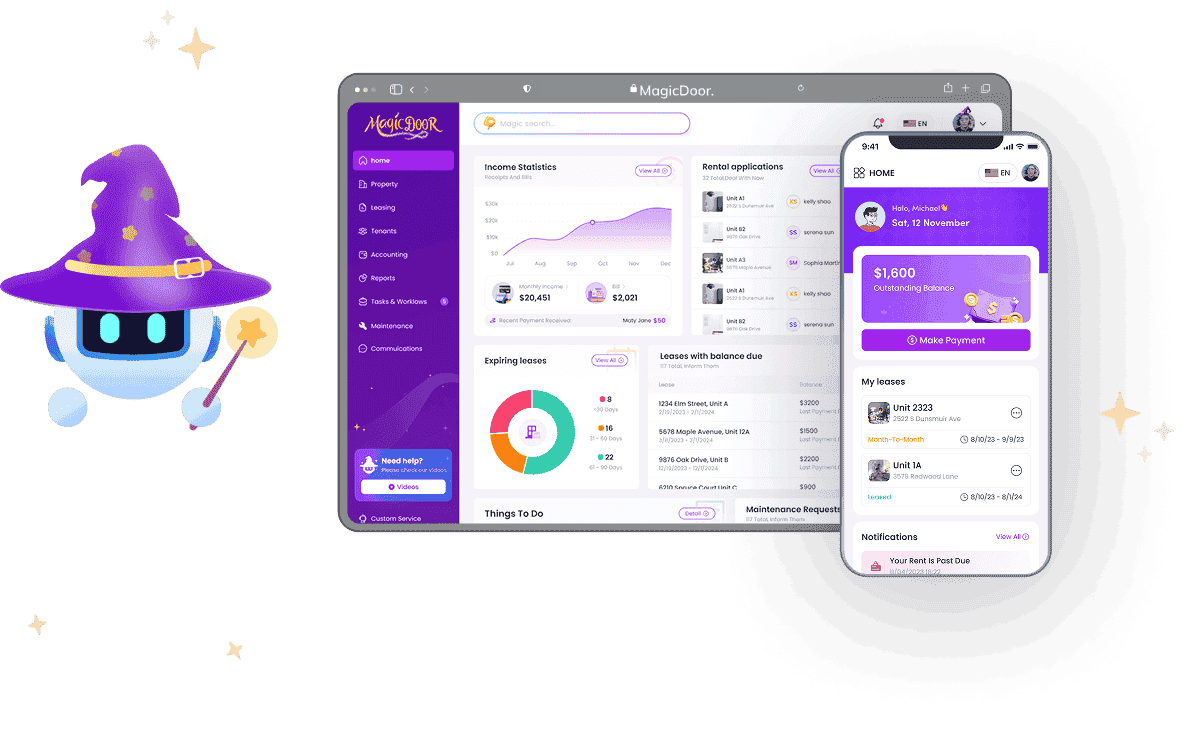
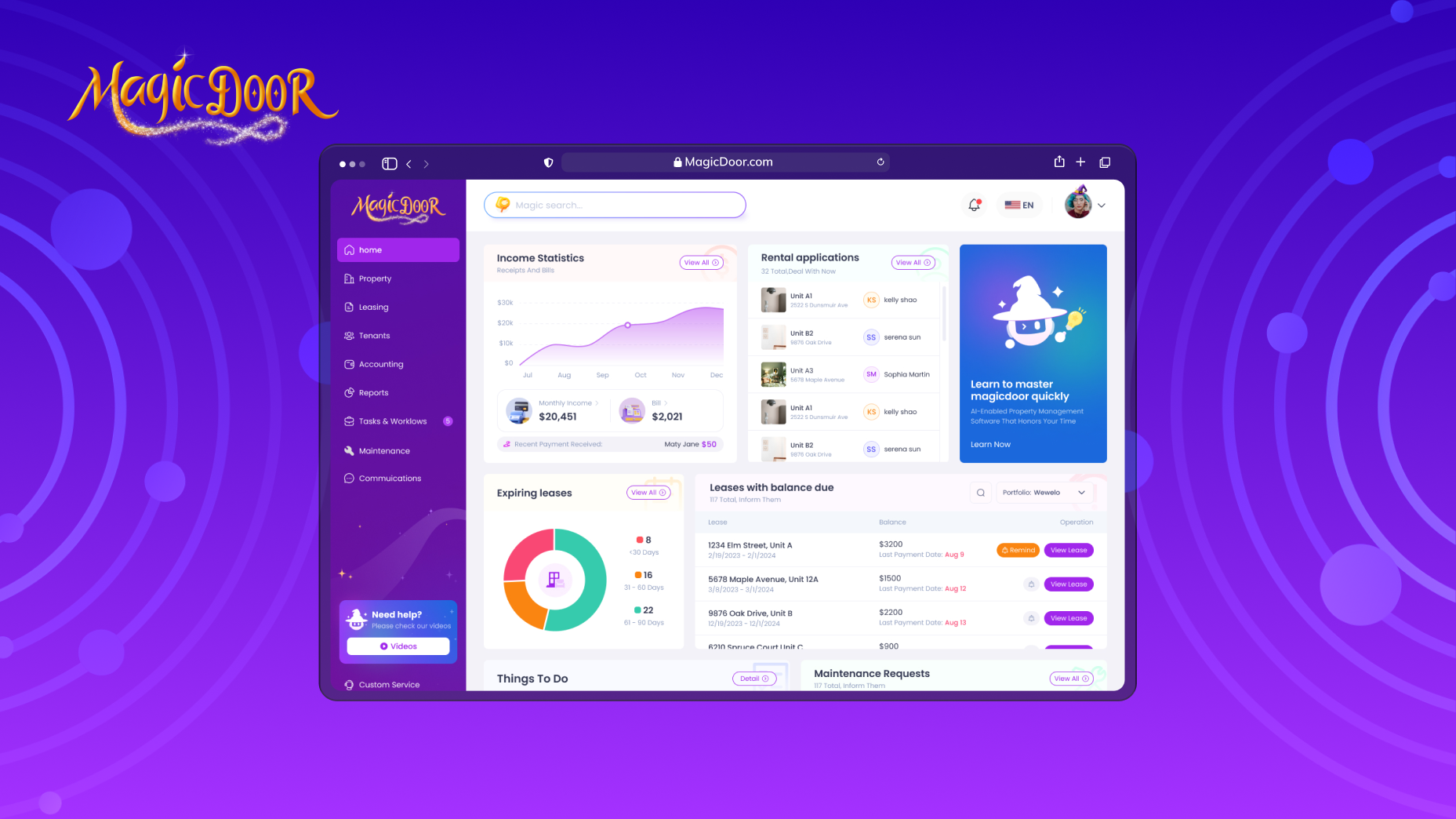
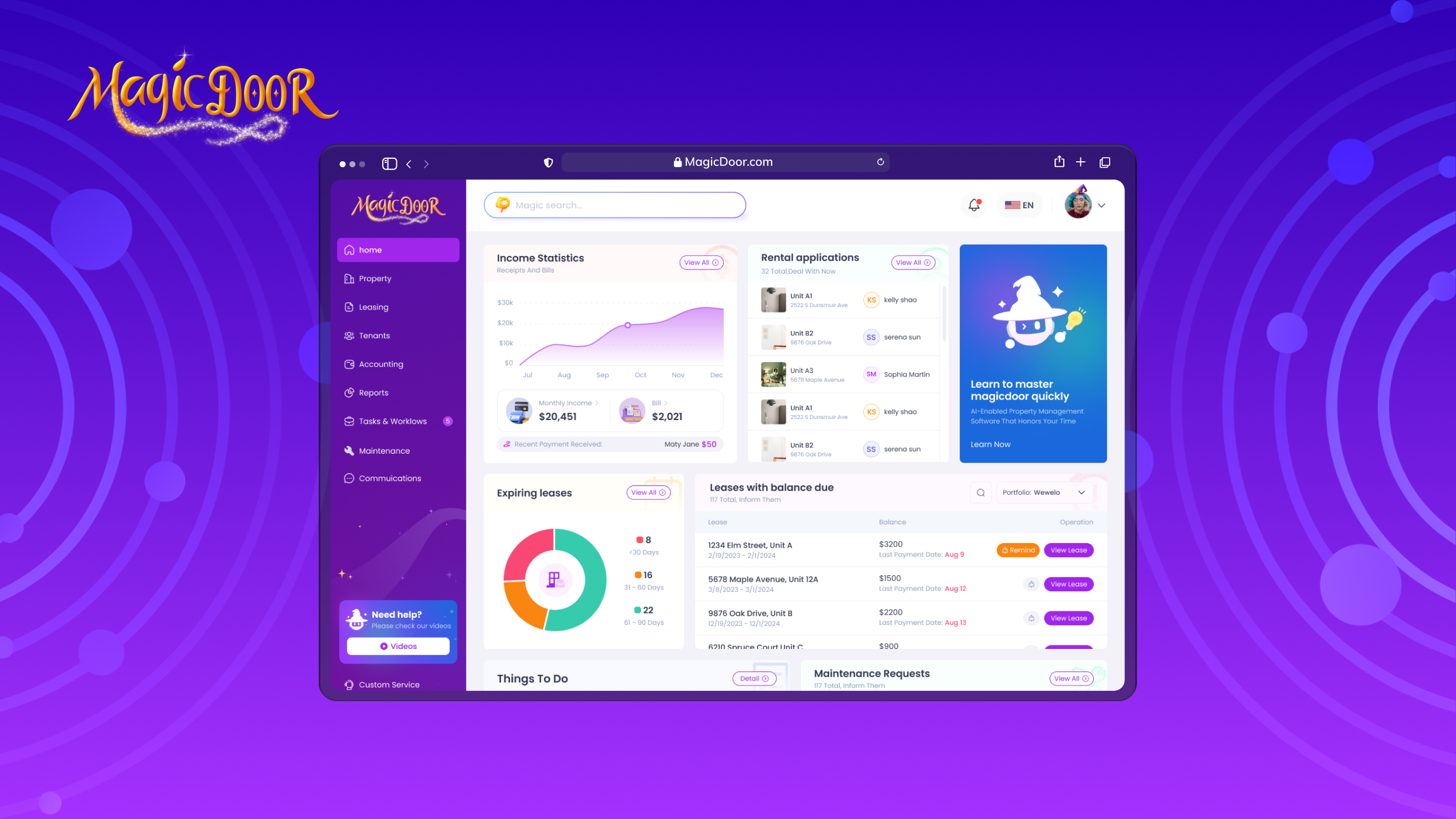
Rent collection breaks down in predictable places: reminders that don't go out, fees that don't apply consistently, payments that require manual cleanup afterward. MagicDoor's rent collection platform runs the full cycle through a single AI-managed flow, from reminder to deposit.
Before rent is due, tenants receive automated reminders via email, SMS, and in-app notifications. Payments process automatically through ACH transfers, debit cards, or credit cards on a recurring schedule. For tenants who need flexibility, partial payments and installment plans are configurable per tenant, with set due dates, amounts, and frequencies, without bypassing the payment structure for everyone else.
Late fees apply automatically when payment isn't received on time.
AI calculates the charge, notifies the tenant directly, and logs it against the right account. The rule applies the same way across every lease, every month, which matters more than it sounds when managing rent collection across a growing portfolio.
Every transaction posts in real time. Property managers see who has paid, who is late, and what's pending, in one view, without manual tracking. That data feeds directly into MagicDoor's accounting features, where rent income and fee records are already structured and ready for reporting.
Conclusion
The right rent collection software doesn't just process payments, it removes the manual work that sums up across every unit, every month. There are many AI tools that replace property management tasks.
Automated reminders reduce late payments without follow-up. Customizable late fees apply consistently without exceptions. Transaction records stay organized in one place, which means less reconstruction work when tax season arrives and IRS reporting requirements for rental income apply.
A mobile-accessible platform matters on both ends. Landlords need real-time visibility across their portfolio. Tenants need a payment experience clear enough that delayed rent becomes the exception, not the pattern.
If you're evaluating options, MagicDoor handles the full rent collection cycle, automated reminders, ACH and card processing, late fee enforcement, and real-time reporting, built into a complete property management platform. Check MagicDoor out.
Related articles




One platform for smart AI-automated rental management